Why Oil & Gas in Ghana Specifies Welders Ghana
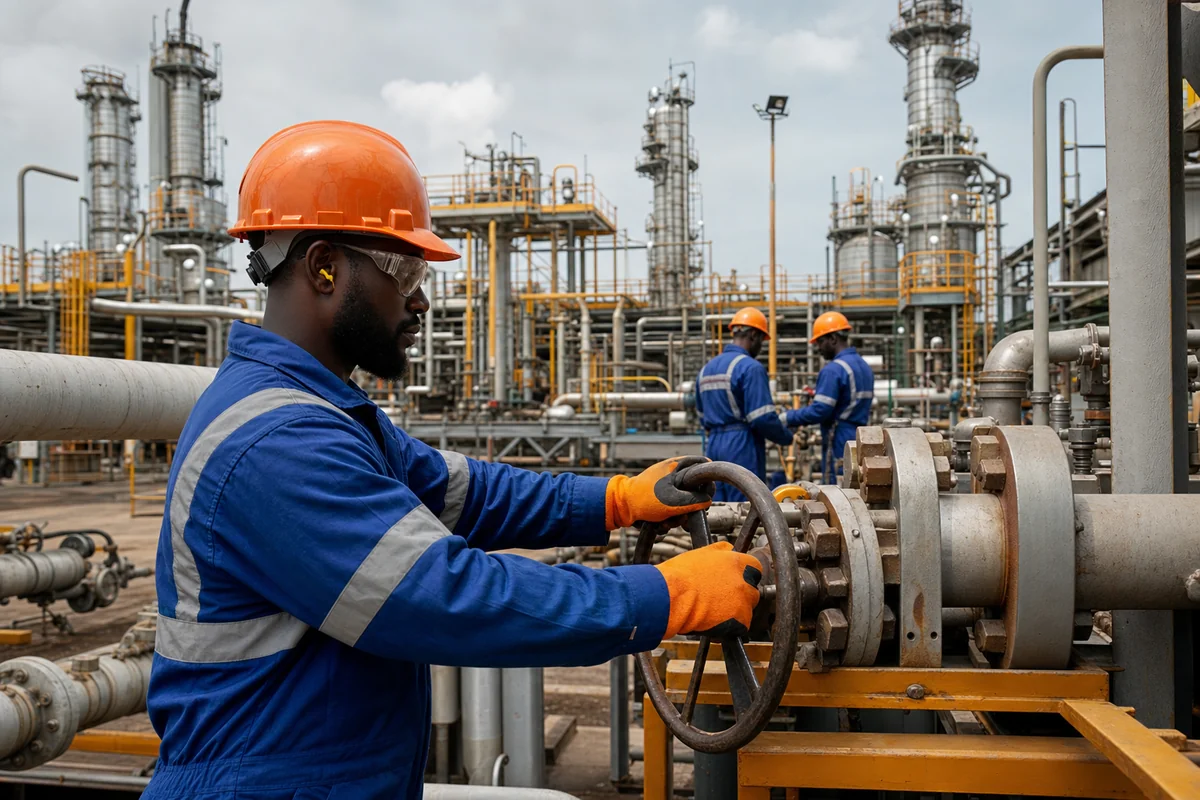
In oil and gas, a weld is a pressure boundary. A pipe joint, a flange weld, or a process line carries hydrocarbons, steam, or pressurised fluid — and a defect that would be cosmetic on a gate becomes a leak, a fire risk, or a shutdown on a process line. Operators and contractors along the Takoradi corridor and the Western Region’s oil-and-gas supply chain specify welders who weld pipe to a coded practice, qualify to a recognised standard, and back the joint with non-destructive testing and records.
Welders Ghana has welded pipework and fabrication for over 15 years. We understand that in this sector the documentation is not paperwork — it is the proof that the joint is fit to hold pressure. We weld from the isometric and the procedure, qualify our welders to the process and position, and hand over the inspection trail that lets an integrity engineer accept the line.
What Oil & Gas Welding Demands
Pipe & Process-Line Integrity
Pipe welds are root-and-fill welded to a qualified procedure — TIG root for clean, full-penetration joints where the service demands it, with fill and cap to the wall thickness — by welders qualified to ISO 9606. Flange welds, branch connections, and tie-ins are made to hold pressure across the design life of the line, not to look finished on handover day.
NDT, Inspection & Pressure Verification
Process and pipeline welds are verified by non-destructive testing — visual, dye-penetrant, radiography, or ultrasonic as the procedure calls for — and the records are supplied so the line can be accepted and, where required, pressure-tested. We test to the spec the service demands, with traceability from procedure to joint.
Containment, Materials & Service Conditions
Oil-and-gas service brings corrosive media, temperature cycling, and demanding materials — carbon steel, stainless, and alloy pipe. We match the consumable and procedure to the parent material and the service, so the weld does not become the weak point in a line built to contain pressure for decades.
Our Oil & Gas Welding Scope
- Oil & Gas Pipe Welding — root-and-fill pipe welding, flange welds, branch connections, and tie-ins to a qualified procedure
- Certified Welding Inspection — NDT and inspection records for pipeline and process-weld integrity
- On-Site Welding — mobile pipe welding brought to the facility for tie-ins, alterations, and urgent repairs
Standards & Compliance
- Welder qualification to ISO 9606 — qualified to the process, position, and material the pipework demands
- Welding-quality management to ISO 3834 — qualified procedures, consumable control, and weld records
- Structural and support steel to AWS D1.1 and EN 1090 where the project includes pipe racks, skids, or structural fabrication
- Non-destructive testing — visual, dye-penetrant, radiography, and ultrasonic on pressure welds, with inspection records and traceability supplied
- Over 15 years in the trade — a workshop with qualified welders and a documented welding method, not a roadside operation
On-Site & Rapid Response
A leaking tie-in, a cracked flange weld, or a failed support on a live facility is a containment and production problem at once. Welders Ghana runs a same-day on-site response line — mobile pipe-welding plant brought to the site, the failure assessed against the procedure, and the repair welded and verified where the facility’s permit-to-work allows. In oil and gas, a fast, competent, documented response keeps a small failure from becoming a shutdown.
Oil & Gas Across Ghana
We weld for oil-and-gas and process clients across Takoradi and the Western Region corridor, the Tema industrial and tank-farm area, and through Accra, Obuasi, and Kumasi. Send the isometric or describe the line and we will arrange a site survey and price the work — never a flat per-joint figure down the phone.